“Aeronova” — a new class of aerial logistics for the Arctic and Siberia.
We build next-generation airships — from unmanned and hybrid systems to rigid heavy-lift platforms. The goal is to become an infrastructure platform for aerial logistics in regions where conventional aviation is too costly or simply ineffective.
Aeronova’s mission is to make hard-to-reach territories economically accessible for people and business.
The North, the Arctic, taiga regions, highlands, and remote areas are not only resource zones, but also hundreds of settlements where reliable logistics remains a matter of survival. Conventional aviation is too expensive here, and ground infrastructure is often impossible.
Aeronova develops a lineup of next-generation airships capable of delivering cargo and people to places with no roads — and where roads will not appear for decades. We are building the foundation of future aerial infrastructure that connects strategically important territories in Russia and worldwide.
Why now: a window of opportunity
Import substitution in aviation, growth of Arctic programs, the climate agenda, and demand for low-carbon transport create a window of opportunity for a new class of aircraft.
A global logistics challenge
Delivering goods to remote regions can cost multiples more than to central areas. This slows down the development of industry, infrastructure, and quality of life for millions of people—especially in northern regions.
A new infrastructure class
Aeronova airships are the foundation for a networked aerial infrastructure: from scheduled cargo routes and tourism itineraries to monitoring platforms, emergency response, and special missions.
Aeronova airship technology
Aeronova projects combine non-rigid, hybrid, and rigid designs intended for long-term operation in harsh climates. This is not a restart of old concepts, but a rethinking of airships using modern materials, aerodynamics, and digital control systems.
- Composite frames and optimized load paths for rigid airships (NOVA-35).
- Distributed electric propulsion and hybrid powertrains for non-rigid and hybrid airships.
- In-house software for monitoring loads, envelope condition, and flight dynamics.
- Integration with navigation systems, communications channels, and remote monitoring systems.
- NOVA-series mockups and prototypes that reduce technological risks step by step.
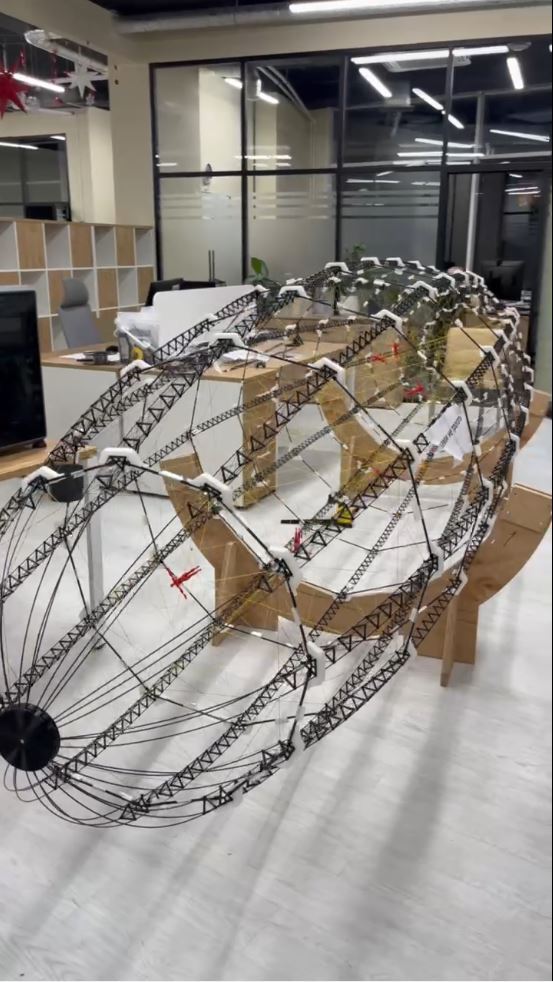
The large-scale mockup (1:20) helps validate assembly technology, stiffness, weight optimization, and prepares the transition to a full-size rigid airship.
A long-term technology barrier
Exclusive design solutions and in-house software create an advantage that cannot be replicated without years of R&D.
Certification readiness
Our design and testing approach is aligned with future certification requirements for airships and hybrid aerial vehicles.
Flexible applications
A modular payload architecture (monitoring, cargo, tourism, emergency response) enables adaptation to civilian, infrastructure, and special tasks.
Aeronova airship lineup
The Aeronova lineup includes demonstrators, cargo platforms, and forward-looking solutions for different use cases—from technology validation to large-scale cargo logistics.
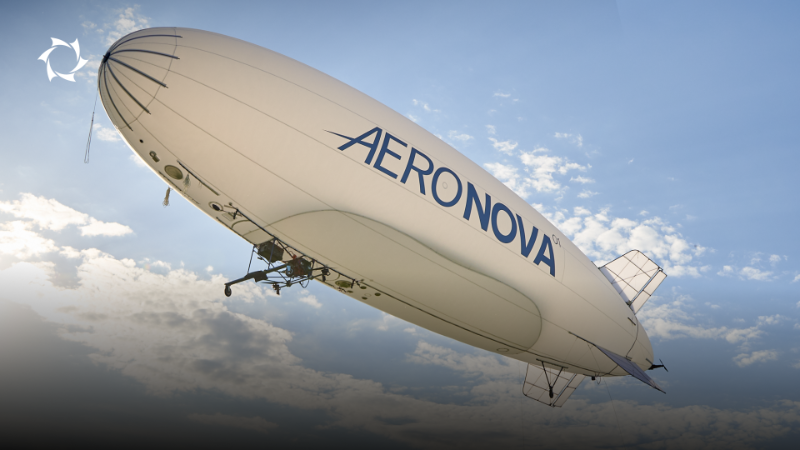
NOVA-01 (demonstrator)
A compact technology demonstrator: control, stabilization, and experimental design solutions. Used to reduce risks before building larger airships.
Stage: testing of individual components and subsystems.
NOVA-2 (experimental aircraft)
A mid-size platform for the next stage—testing layout, aerodynamics, control systems, power architecture, and composite elements before scaling up to large airships.
Stage: preparation for assembling the prototype.
NOVA-35 (rigid cargo airship)
A flagship platform about 120 m long with a volume of ~35,000 m³. Designed for cargo logistics in hard-to-reach regions—the Arctic, Siberia, mountain areas, and disaster zones.
Stage: structural mockup, preparation for a full-scale prototype.
Key use cases
Aeronova airships solve tasks where traditional aviation is too expensive, and ground infrastructure is impossible or economically inefficient.
Arctic and northern logistics
Delivering cargo to deposits, settlements, and infrastructure sites without building roads, bridges, or runways—especially relevant for regions such as Yakutia.
Industry and construction
Transporting oversized structures and equipment in areas with limited infrastructure, including renewable energy, power lines, and pipeline projects.
Emergency response and humanitarian aid
Rapid delivery of humanitarian supplies, modular hospitals, and equipment to disaster and natural hazard areas with minimal infrastructure requirements.
Surveillance and monitoring
Long-duration missions for observation, infrastructure and environmental monitoring using electro-optical systems and telecom equipment.
Tourism and expeditions
Sightseeing and research flights to unique natural areas with minimal impact on ecosystems and minimal infrastructure requirements.
Dual-use potential
Potential to address dual-use tasks for government agencies and corporate customers.
Market and economic potential
Remote logistics, Arctic programs, and northern territories represent a multi-billion-dollar market with no dominant player offering a truly new-class solution yet.
- Growing demand for infrastructure in the Arctic and the North.
- Expansion of extraction projects, renewables, logistics, and digital services.
- Demand to reduce transport carbon footprint and provide an alternative to helicopter logistics.
- Interest from regions (including Yakutia) in sustainable aerial mobility without roads.
Settlements, deposits, and infrastructure sites without roads or runways.
Potentially multi-fold lower delivery costs compared to conventional aviation.
Long corridors between key points across the North and the Arctic.
Formation of a new aerial infrastructure class and expansion to international markets.
Dubai Airshow 2025 interview on how the market is evolving
Aeronova’s chief designer discusses demand for next-generation airships, investor interest, and future application areas
Aeronova development roadmap
The roadmap outlines the path from R&D and early prototypes to full-scale flight testing and the launch of regular operations in target markets.
Concept development, creation and testing of NOVA-01, building the engineering school and core technologies.
Launch of NOVA-2 assembly, preparation of the hybrid AEROLET-01, and deployment of a production base for a series lineup.
Test flights of NOVA-2 and AEROLET-01, demonstration on northern routes, and preparation for commercial operations.
Transition from the NOVA-35 large-scale mockup to a full-size aircraft, lineup launch, and expansion to domestic and international markets.
Project progress
We are steadily advancing through the key stages of the NOVA lineup and expanding our production infrastructure.
NOVA-01 is back in the sky
The NOVA-01 airship has been upgraded and returned to flight testing, confirming technology reliability and opening the way for new missions.
NOVA-2 and AEROLET-01
The NOVA-2 project has officially entered the assembly stage; engines and gondola elements are being prepared, while the hybrid AEROLET-01 is in final preparation for launch.
NOVA-35 and production base
Assembly of the NOVA-35 rigid airship large-scale mockup is underway; envelope production and assembly workshops are being equipped; the company’s infrastructure and office are expanding.
Media about us
Federal and regional TV channels cover how next-generation airships are developing in Russia and the role Aeronova plays in shaping the future of aerial mobility.
Modern airships on air
An NTV feature shows how airship building is being revived and what niche Aeronova’s innovative airships occupy in logistics and monitoring.
Source:
ntv.ru
The return of airships
The федеральный channel “Russia 1” talks about airships returning to the transport system and highlights the “Next-generation airships” projects as an example of a high-tech initiative.
Source:
smotrim.ru
The North and new solutions
A regional TV channel covers the airship opportunity for Yakutia: lower logistics costs, tourism development, and improved infrastructure access in hard-to-reach areas.
Source:
Yakutia 24
Aeronova team
At the core are engineers, designers, software developers, and managers with experience in aviation, mechanical engineering, and full-cycle high-tech projects—from R&D to engineering tests.

Sergey Semyonov
Chief Executive Officer
Strategic company development, engagement with partners, investors, and government institutions.

Fyodor Konstantinov
Chief Technology Officer
Technology strategy, R&D, development of the structural frame, control systems, and test programs.

Design bureau & development team
Engineers & designers
Structural design, calculations, modeling, mockups, preparation for prototyping and scaling production processes.
Project economics and business model
Aeronova is being built as an infrastructure company with multiple revenue streams and the potential to expand into international markets.
Revenue model
- Manufacturing and supply of airships and components.
- Operational services and leasing of aircraft.
- “Logistics as a Service” for corporate and government customers.
Customer benefits
- Lower total delivery cost and reduced infrastructure CAPEX.
- No requirements for roads or runways.
- Operation in harsh climates with low noise and emissions.
Scaling potential
- Expansion of fleet size and flight geography.
- Entry into international markets for remote logistics and monitoring.
- Development of a network infrastructure based on multiple airship types.
For Aeronova project investors
You can participate in financing the development of next-generation airships at an early stage, as the foundation of a future infrastructure company is being formed and the NOVA-series lineup is being deployed.
Why it’s interesting
- A market with high entry barriers and a shortage of players.
- Potential for multi-fold growth in project value as operations launch.
- Long development horizon and scalable aircraft lineup.
Participation format
Participation terms, structure, and investment format are described in the project’s investment materials and contractual documentation. The project is being developed with support from an international investor community through the Solargroup crowdfunding platform.
Transparency
Regular news and progress reports, demonstration of key development milestones, coverage of production sites, and participation in international exhibitions.
You can learn more about the terms, legal structure, and participation format in the investor dashboard.
Frequently asked questions
How do Aeronova airships differ from classic airships?
They use modern composite materials, distributed propulsion, digital control systems, and modular payloads. The lineup includes non-rigid, hybrid, and rigid aircraft for different tasks.
What stage is the project at now?
R&D and expansion of the production base are ongoing. NOVA-01 is in flight testing; NOVA-2 has entered the assembly stage; a large-scale mockup of the NOVA-35 rigid cargo airship is being built; the hybrid AEROLET-01 is being prepared for launch.
Where can I follow progress?
Project updates are published on the official website, blog, social media, and investor newsletters. Selected events are covered by federal and regional media.
How can I contact you about investment questions?
Use the contacts below or email the official address. The team will provide materials and answer your questions about participation.